

CoinTracking Review 2026: The Best Crypto Tax Software for Serious Investors — Or Overkill for Beginners?
Overview
Overall Rating: 8.9 / 10 ⭐⭐⭐⭐
Tracking Crypto Taxes Manually Is a Nightmare
If you’ve traded crypto for more than a few months, you’ve probably experienced the moment of panic.
Tax season arrives.
You open your exchange accounts.
You realize you’ve made hundreds—or thousands—of transactions across multiple wallets, exchanges, staking platforms, and DeFi protocols.
Suddenly, calculating your gains and losses isn’t just annoying.
It’s practically impossible.
According to multiple tax professionals, cryptocurrency investors frequently underestimate how complex tax reporting becomes once they move beyond simple buy-and-hold investing. Add staking rewards, NFTs, DeFi swaps, margin trading, and cross-chain transfers, and spreadsheets quickly become unmanageable.
This is exactly the problem CoinTracking aims to solve.
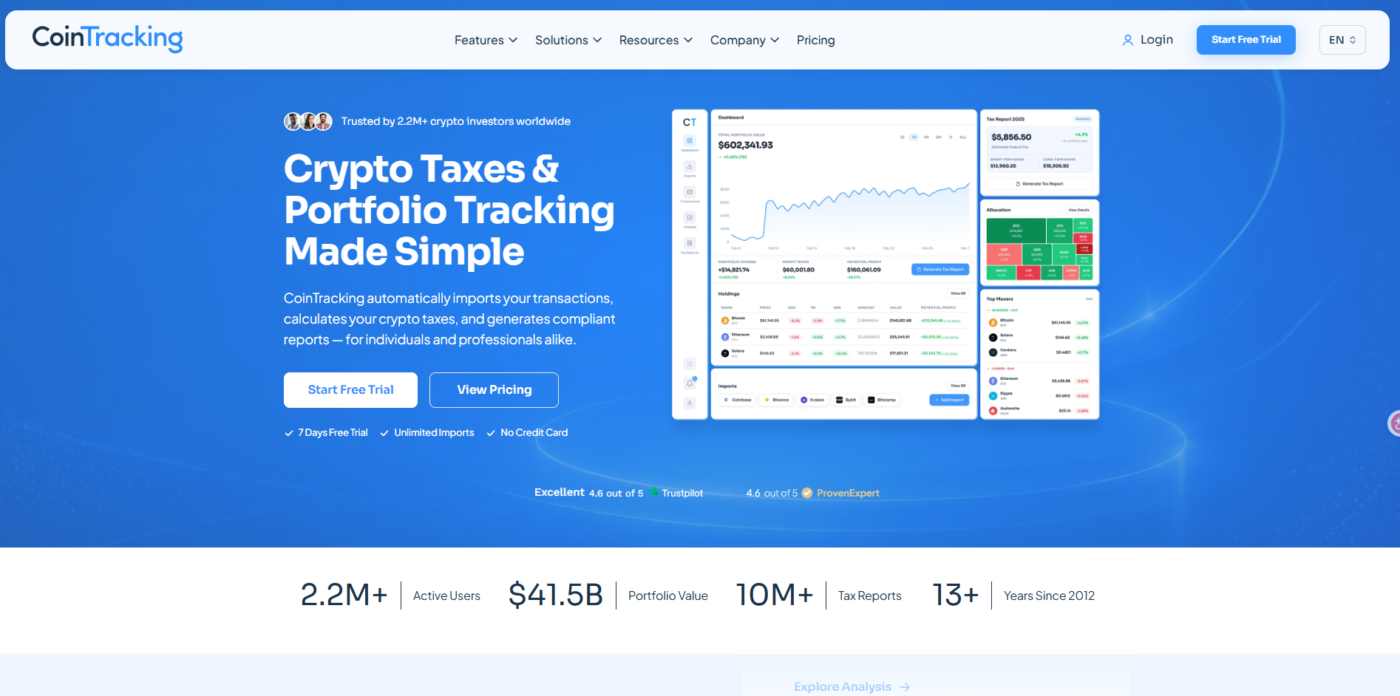
The platform automatically imports transactions, tracks portfolio performance, calculates gains and losses, and generates tax reports compatible with numerous jurisdictions worldwide.
The promise sounds straightforward:
Connect your wallets and exchanges, let the software do the math, and avoid tax-season headaches.
But after more than a decade in business and serving over a million users, is CoinTracking still the best crypto tax platform available, or have newer competitors surpassed it?
After examining its features, pricing, user feedback, and alternatives, here’s the honest answer.
Brand Background
CoinTracking was founded in 2012, making it one of the oldest cryptocurrency portfolio tracking and tax reporting platforms in the industry.
That’s important because longevity matters in crypto.
Many crypto startups disappear after a few market cycles.
CoinTracking has survived:
- The 2013 crypto boom
- The 2017 bull market
- Multiple bear markets
- DeFi expansion
- NFT adoption
- Institutional crypto growth
Today, the platform reports more than 1.9 million users globally and supports transaction imports from hundreds of exchanges, wallets, and blockchain networks. It has become one of the most recognized names in crypto accounting software.
Unlike many newer competitors that focus primarily on tax generation, CoinTracking was originally built as a portfolio analytics platform.
As a result, it offers significantly deeper tracking, reporting, and performance analysis capabilities than many tax-focused alternatives.
The company’s primary audience includes:
- Active crypto traders
- High-volume investors
- DeFi participants
- Mining operators
- Professional accountants
- Crypto-focused tax professionals
This focus on serious investors shapes both the platform’s strengths and weaknesses.
Product Deep Dive
Exchange and Wallet Integration
The Problem
Most crypto investors don’t use just one platform.
A typical investor might have assets spread across:
- Binance
- Coinbase
- Kraken
- MetaMask
- Ledger
- Trust Wallet
- DeFi protocols
Tracking everything manually becomes increasingly difficult.
How CoinTracking Solves It
CoinTracking supports imports from hundreds of exchanges and wallets through:
- API integrations
- CSV imports
- Blockchain syncing
- Manual transaction entry
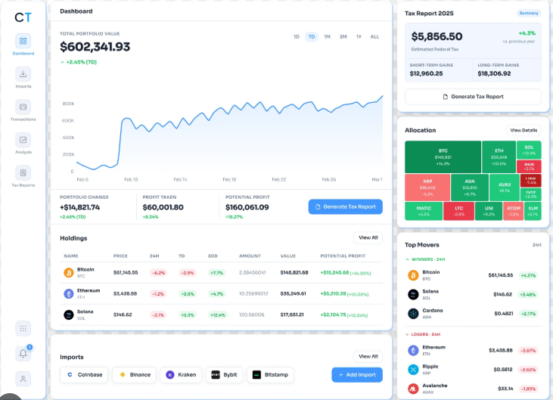
The platform consolidates transactions into a single dashboard.
Why It Matters
Without centralized tracking, investors often lose visibility into:
- Cost basis
- Profit and loss
- Asset allocation
- Tax obligations
This becomes particularly valuable for active traders who may generate thousands of transactions annually.
Crypto Tax Reporting
The Problem
Crypto taxation is far more complicated than many investors expect.
Taxable events may include:
- Selling crypto
- Swapping tokens
- Staking rewards
- Mining income
- NFT sales
- Certain DeFi activities
Even experienced investors frequently struggle to calculate accurate gains.
How CoinTracking Solves It
CoinTracking automatically calculates gains and losses using various accounting methods, including:
- FIFO
- LIFO
- HIFO
- Average Cost
The platform generates tax reports designed for multiple countries and tax systems.
Why It Matters
For investors with substantial transaction histories, this can save dozens of hours compared to manual calculations.
More importantly, it reduces the likelihood of reporting errors.
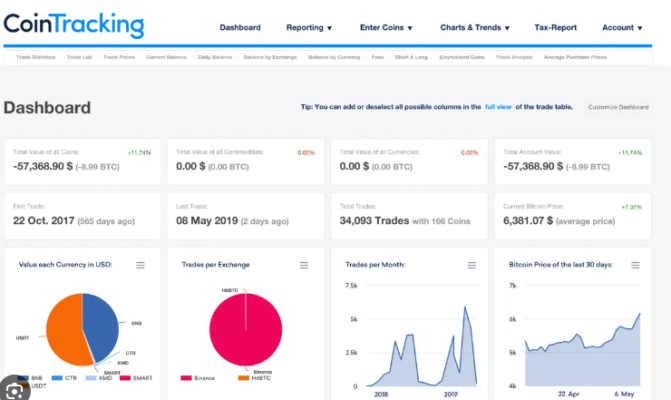
Portfolio Analytics
The Problem
Many crypto tax tools only focus on compliance.
They tell you what you owe.
They don’t help you become a better investor.
How CoinTracking Solves It
This is one of CoinTracking’s strongest areas.
The platform provides detailed analytics including:
- Historical portfolio value
- Asset allocation
- Trade performance
- Realized gains
- Unrealized gains
- Risk analysis
- Performance benchmarking
Why It Matters
Understanding investment performance is often just as valuable as calculating taxes.
Many users continue using CoinTracking year-round because of its analytics rather than solely for tax reporting.
DeFi and Advanced Transaction Support
The Problem
Many crypto tax platforms struggle with DeFi.
Transactions involving:
- Liquidity pools
- Yield farming
- Lending protocols
- Cross-chain transfers
often create reporting problems.
How CoinTracking Solves It
CoinTracking has steadily expanded support for complex transaction types and blockchain integrations.
The platform handles many advanced crypto activities more effectively than older tax software systems.
Why It Matters
For serious crypto participants, support for advanced transactions isn’t optional.
It’s essential.
Without it, manual reconciliation becomes unavoidable.
Professional Reporting Tools
The Problem
Large portfolios generate complicated records.
Professional accountants require detailed documentation.
How CoinTracking Solves It
The platform offers extensive reporting features including:
- Capital gains reports
- Tax summaries
- Audit trails
- Trade histories
- Income reports
- Asset reports
Why It Matters
These tools make CoinTracking particularly attractive to tax professionals and high-net-worth investors.
This is one area where it often outperforms simpler competitors.
Real-World Performance
CoinTracking has built a strong reputation among experienced crypto investors.
Users consistently praise:
- Extensive exchange support
- Accurate tax calculations
- Detailed reporting
- Advanced analytics
- Long-term reliability
Many long-term customers report using the platform for years due to its comprehensive tracking capabilities.
However, the platform receives recurring criticism in one area:
Complexity.
New users frequently describe the interface as overwhelming.
The software exposes a huge amount of information, which is beneficial for power users but intimidating for beginners.
Several users also report that transaction reconciliation occasionally requires manual adjustments, particularly when dealing with complex DeFi activity.
This isn’t unique to CoinTracking.
Virtually every crypto tax platform faces similar challenges.
Still, it’s worth noting that automated imports aren’t always perfect.
Users should verify results before filing taxes.
Overall, CoinTracking performs best for investors willing to spend time learning the platform.

Pricing Analysis
CoinTracking offers both free and paid plans.
Free Plan
Supports up to 200 transactions.
Suitable for:
- Casual investors
- Buy-and-hold users
- Platform testing
Pro Plans
Paid plans increase transaction limits and unlock advanced reporting features.
Pricing generally ranges from approximately:
- Around $12–$20/month for lower tiers
- Higher annual plans for active traders
- Premium plans for professionals and very high transaction counts
Compared to competitors:
| Platform | Starting Paid Pricing |
|---|---|
| CoinTracking | ~$12-$20/month |
| Koinly | ~$49/year+ |
| CoinLedger | ~$49/year+ |
| TokenTax | $65-$199+/year |
| CryptoTaxCalculator | Similar premium pricing |
For active traders generating thousands of transactions, CoinTracking often delivers strong value.
For occasional investors, the cost may feel unnecessary.
Honest Limitations
1. The Interface Feels Dated
This is easily the most common criticism.
CoinTracking prioritizes functionality over aesthetics.
Compared to newer competitors, the interface can feel cluttered and overwhelming.
Dealbreaker?
No.
But first impressions matter.
2. Steep Learning Curve
Beginners often struggle initially.
Understanding:
- Tax settings
- Import options
- Accounting methods
- Portfolio reports
requires time.
Dealbreaker?
Not for serious investors.
Potentially for casual users.
3. DeFi Still Requires Verification
Despite strong support for advanced transactions, users should not assume every transaction imports perfectly.
Complex DeFi activity often requires review.
Dealbreaker?
No.
But trust-and-forget automation isn’t realistic.
4. More Features Than Many Users Need
CoinTracking is powerful.
The downside is that many investors only need 20% of what it offers.
Some users may end up paying for capabilities they never use.
Dealbreaker?
Only if simplicity is your priority.
Competitive Comparison
CoinTracking vs Koinly
Choose Koinly if:
- Ease of use matters most.
- You want a cleaner interface.
Choose CoinTracking if:
- Analytics matter.
- You manage large portfolios.
CoinTracking vs CoinLedger
Choose CoinLedger if:
- Simplicity is your top priority.
- You only need tax reports.
Choose CoinTracking if:
- You want year-round portfolio management.
CoinTracking vs TokenTax
Choose TokenTax if:
- Concierge tax support is important.
Choose CoinTracking if:
- You prefer more self-service control.
- Analytics matter more than white-glove assistance.
Overall, CoinTracking remains one of the most feature-rich platforms in the crypto tax industry.
Who Should Buy CoinTracking?
Ideal For
- Active crypto traders
- DeFi participants
- Long-term crypto investors
- Professional accountants
- High-net-worth investors
- Users managing multiple exchanges
Probably Not For
- Complete beginners
- Investors with fewer than 50 transactions annually
- Users seeking the simplest possible interface
- People who only need basic tax reports
Final Verdict
CoinTracking isn’t the easiest crypto tax platform to learn.
It isn’t the prettiest.
And it certainly isn’t the simplest.
What it is, however, is one of the most comprehensive crypto portfolio tracking and tax reporting tools available today.
The platform’s greatest strength is depth.
If you’re an active trader, DeFi investor, or serious crypto participant, CoinTracking provides reporting and analytics capabilities that many competitors struggle to match.
For casual investors, it may feel like overkill.
For power users, it’s often exactly what they need.
Detailed Scorecard
| Category | Score | Honest Assessment |
|---|---|---|
| Tax Reporting Accuracy | 9.2/10 | Strong support for complex tax calculations |
| Exchange Integrations | 9.4/10 | Extensive platform compatibility |
| Portfolio Analytics | 9.5/10 | One of the best in the industry |
| DeFi Support | 8.8/10 | Strong but still requires verification |
| Reporting Tools | 9.3/10 | Excellent for serious investors |
| Ease of Use | 7.2/10 | Significant learning curve |
| User Interface | 7.0/10 | Functional but dated |
| Value for Money | 8.8/10 | Excellent for active traders |
| Customer Support | 8.2/10 | Generally reliable |
| Scalability | 9.4/10 | Handles large portfolios effectively |
| Overall Rating | 🌟 8.9 / 10 | Best suited for serious crypto investors |
Disclaimer
This review is for informational purposes only and does not constitute tax, legal, accounting, or investment advice. Cryptocurrency tax regulations vary significantly by jurisdiction, and investors should consult a qualified tax professional before filing returns or making financial decisions.